

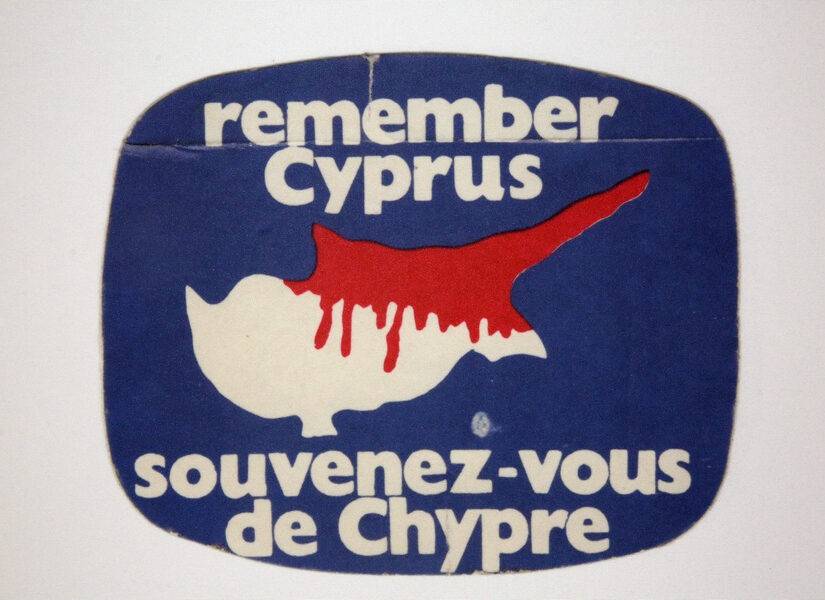
"I expected the Greeks to retreat, not to get out of their way"!
 DROSOS DIONYSSIS
The area defined by the Hellespont, Aegean Sea, Crete, Cyprus, Eastern Mediterranean, to Suez, constitutes a single geopolitical region. Its control has enormous geostrategic value at a global level. If it is controlled by a single state entity, it becomes a particularly powerful and international power with critical weight. Two long-lived empires relied on the control of this crucial axis on the global chessboard: The Eastern Roman Empire and the Ottoman Empire. Powerful empires, with a total duration, cumulatively, of 15 centuries.
The crisis and dissolution of the Ottoman Empire coincided with the process of national self-determination of the ethnicities that composed it, starting with the Greek Revolution that led to the secession of a part of the Empire, the formation of the Greek national state, which on the one hand did not include the entire Hellenism under Ottoman rule, but on the other hand, mortally wounded the once powerful empire, making it what was called the "great sick man" until its final dissolution.
And although its downward course had already begun long before, the important diplomatic issue of dividing its garments has now arisen. This new situation has the following coordinates:
- Feverish involvement of the great powers, none of which wishes to see all this lost power concentrated in the hands of its competitors.
- An irredeemable issue in the newly established Greek state, which leaves out perhaps the most important parts of Hellenism; an issue that is now expressed as the country's dominant ideological flag, under the title "Great Idea",
- Processes within the Empire that prepare the formation of a Turkish national state, in as much of the geographical part of the Empire as can be saved.
The Great Idea, a national strategy within the limits allowed by foreign dependencies, with decade-long wars, sometimes with skillful exploitation of opportunities that expanded Greek territory, sometimes with adventurism, but always with division, ended up involving the country in international imperialist games beyond its powers and was led to a painful end with the Asia Minor Catastrophe of 1922. A catastrophe that was at the same time the founding act of the Turkish national state.
For Hellenism, however, it was experienced as a heavy defeat, as it really was, as it was forced to abandon ancient cradles and centers of its culture. Through an adventurous succession of coups and pronouncements, during the interwar period, the ruling class finds a substitute for a national ideology after the definitive lowering of the flag of the Great Idea. This substitute is other-defined and negative: Anti-communism. It was not an originality or invention of the Greek elites, of course. Nor was the Turkish regime any less anti-communist.
Cyprus-Aegean-Thrace
The big difference is that in Turkey, since its founding, the nation-state had and has a clear orientation towards the reconstitution, if not of the entire old empire, but certainly, towards the revision of the Treaties that it was forced to sign in moments of weakness and, as far as we are concerned, the regaining of control of the unified strategic space that we tried to describe at the beginning.
This orientation is nationwide in Turkey. And it is not limited to celebratory and megalomaniacal events – although it is not stingy with these either – but to cool-headed strategic planning, which with flexibility but also patient focus is followed by all Turkish governments and has the consensus of the entire political spectrum, including the Left.
And this plan is clear: Cyprus-Aegean-Thrace. It has been explicitly formulated (by the constitutionalist, columnist and advisor to Denktash, Mümtaz Soysal) but even if it had not been clearly stated, the simple monitoring of Turkish movements confirms that this is what it is about. This is as far as we are concerned, since Turkey also has other strategic fronts of interest.
Cyprus: Absence of a Greek national strategy
Anti-communism in Greece, however, functioned as a fig leaf that covered the absence of a national strategy other than that of compliance with the interests of the “allied factor”. Already very early on – after 1922 – the Cypriot uprising in 1931 did not have the fate of the Cretan revolution, it was not supported by the mother country, since the interests of the “friend” Great Britain, which had purchased Cyprus in 1889 from the Ottomans, who had in fact renounced all their rights over the island through the Treaty of Lausanne (articles 16 and 20), should not be affected.
Of course, on the international anti-communist front, our country had to play a role that was by definition subordinate to that of Turkey, since the latter, although diminished, after the fall of the Empire, continued to maintain a much more important geopolitical position than Greece, since the anti-communist camp was mainly faced with Russia, the then USSR. Mainly, however, the defeat of 1922 decided the question of which power of the two would have the upper hand on this geostrategic front.
Moreover, Turkey did not experience, thanks to the policy of “artful neutrality”, neither war, nor occupation , nor of course, civil war. With the civil war, in Greece, the anti-communist ideology is consolidated and becomes not only the substitute for national strategy, but the pool of Siloam, even for national inferiority and betrayal. Until 1974, “national” is called anything that is simply anti-communist. Even the collaborators of the occupation troops are washed clean, even baptized “national resistance”, since they contributed to the suppression of the great ideological enemy.
The fact that the ruling class was unable to save itself from the civil war, except with the help of the “allied factor”, tied it to it with even stronger ties of dependence. However, we do not forget that the Truman Doctrine that saved the situation was a program of significant reinforcement of the entire wing covered by Greece and Turkey. It was not a reward for the enormous services that our country offered to the allied struggle, but for a serious and considered economic and military reinforcement of the Atlantic alliance in the region crucial for containing the Russians.
Turkey is back in the game
To avoid misunderstandings, I would like to remind you that this text does not concern us with the assessment of the civil war itself. Regardless of its outcome, the fact of the civil war itself constituted a national defeat for Greece. I am only interested here in pointing out certain consequences that are related to our topic and which concern the fate of all Greeks, on whatever side they found themselves in this disastrous war in every respect.
We all now understand that if the Nation could not unite under the Great Idea and was divided, there was no way it could unite under an ideological flag that was divisive par excellence. The flag of anti-communist nationalism. In the meantime, of course, the composition, as well as the economic, political and moral characteristics of the ruling classes, had changed through the occupation and the civil war. And above all, their ability to lead a national strategy.
Turkey, despite joining the same camp as us, never gave up its own national program. The map of the Turkish headquarters remained the same and with patience and vigilance, depending on power and connections, they placed flags in new positions. And if it did not manage to detach the Dodecanese, it nevertheless managed, with the help of the British, to set foot in Cyprus.
The anti-colonial liberation struggle of the Cypriots for Self-Determination-Union, although it was not under leftist leadership – quite the opposite in fact – was not supported by the regime in Athens. The latter, in fact, while the Cypriot fighters were being executed, negotiated with London and Ankara about the concessions it would make to the Turks. At the same time in Athens, the Cyprus issue was the first event that led large sections of the people (including, if not leading, the Left) to the streets, where there were bloody clashes and deaths.
We ended up with the Zurich-London treaties, where now, in violation of the Treaty of Lausanne, Turkey re-enters the Cyprus game as one of the three guarantor powers and with our consent of course. They believed then, as some in Athens later did, that in this way they were getting rid of the “burden” of Cyprus. They did not realize either then or later the possibilities and responsibilities that the status of guarantor country continued to provide to the country, even if jointly with Britain and Turkey.
Cyprus is a burden!
Cyprus would become a supposedly viable independent state, with a constitution that quickly showed its contradictions and non-functionality. As if the undemocratic “equalization” of 18% with 82% of the population were not enough, Greek Cyprus was also hit by a new fatal division. Two rival projects, both problematic and utopian, came into violent conflict.
On the one hand, the idea that Cyprus could go it alone as an independent state, opening the game with the great powers and joining the Non-Aligned Movement, postponing the Union to a more appropriate time. On the other hand, the so-called “unification” part, which essentially promoted a conditional Union with trade-offs with Turkey, access to the sea, a military base or a dual Union.
On the other side of the Aegean, there was no division, but rather a stabilization of the line for the partition and control of as much of Cyprus as possible and the cutting off of the island from Greece, in the first phase. The solution of the Union with exchanges or the dual Union had been rejected by Turkey, which did not want any, not even the slightest, uncontrolled military force in its underbelly, without either the parliamentary or the dictatorial governments in Athens having realized this.
The junta in particular is greatly facilitating Turkish plans. As if it was imposed precisely to finalize this Turkish “solution”, which was also compatible with NATO interests, on the condition that no conflict would be caused between Turkey and Greece. For NATO and its stronghold, Israel, especially after the loss of Suez, Cyprus acquired even greater strategic value and should not under any circumstances be allowed to play games with the non-aligned or with the pro-Soviet bloc.
Thus, one of the first moves of the dictatorship was the withdrawal of the Division from Cyprus, leaving it unprotected. At the Kesani meeting, which preceded it, the Turkish diplomats had the opportunity to perceive and comment in their memoirs, the stupidity, naivety and irrelevance of the representatives of the Greek junta. " I expected that the Greeks would retreat, but I did not expect that they would undress, " Demirel would later say...
"I expected the Greeks to retreat, not to get out of their way"!