

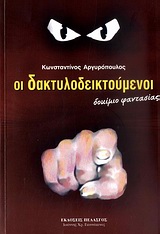
Presentation of the book: 'THE FINGER POINTED', Konstantinos Argyropoulos
The fantasy short story "The Finger-Pointing Ones" by K. Argyropoulos is particularly timely, maintains the reader's interest undiminished throughout its development and ultimately leaves mixed feelings of sadness and reflection, without however becoming depressing, since the text is interspersed with humor, excellent use is made of the Greek language and, in addition, a wide range of issues that concern everyone, either as an individual or as a citizen and member of society, are touched upon.
The author manages to unfold and synthesize the present through the legacies of the past as well as the imperatives of the future. The scenario of the short story, although fictional, is significantly related to current trends and developments in politics, international relations and technology. Above all, however, the scenario is used as a vehicle in order to develop, along its course, the author's national, political, social, economic, moral, religious and philosophical concerns. For this reason, the plot develops at a relatively slow pace and is mainly suitable for those who are more interested in the journey than in the destination.
According to the scenario, the eternally bad nature of man leads to social and transnational stagnation of existing bad relations with ominous conditions for the future. The biotechnological research of the USA undertakes the creation of an improved type of man/model, in order for humanity to move towards virtue and its harmonization with the surrounding nature which, in many ways, touches or even identifies with the Divine. The two original creations of the company "Future Eugenesis", Robert and Roberta, are secretly transported to the selected area of Souli in Epirus in order to perfect themselves by acquiring a soul and subsequently create the perfected model of man, as a result of their love. Ultimately, after many adventures, political expediency and the evil nature of man lead the experiment to failure, without, however, affecting man's timeless and invincible desire for self-improvement and for acquiring the "recipe for happiness," the basic ingredients of which, according to the author, are knowledge, conscience, and self-awareness.
Through the pages of the book, the greatness of ancient Greece is highlighted and philosophical and scientific views of our ancient ancestors such as Plato, Aristotle, Epicurus, Anaxagoras, Theophrastus, Socrates, Heraclitus, Cleoboulos, etc. are presented. At the same time, the sad present of Greece of corruption, immorality, complacency, indifference, poor education, lack of role models, bureaucracy, defeatism, graphic political tactics, corrupt journalists, low birth rate, tax evasion, business interests, the loss of our language, illegal immigrants and managerial policies without vision and national strategy are clearly highlighted. Through the thoughts, plans and actions of characters coming from our country's neighboring environment and the international community, the author expresses his intense concern for our pressing national issues, the country's internal security issues and rebukes social indifference and the spirit of "globalization", "progressivism" and "multiculturalism", the choice of which he considers a Trojan horse for a small nation that leads it to its self-destruction.
K. Argyropoulos vividly describes his characters, while he never misses an opportunity to connect the vivid descriptions of the landscapes of Epirus and the Ionian Sea with our history. His poetic approach to describing landscapes and characters culminates when he literally praises the feminine beauty and the love of the central protagonist Kimon Mazetta for the American scientist Melita Rosanna Kane. In addition, the author introduces the reader to a significant extent to modern technology and its terminology, while highlighting the value of information and how to utilize it.
A series of timeless concerns of common interest excites the reader and forces him to recall his own experiences and opinions in order to contrast them with those of the author. I briefly mention some:
– What is “beautiful” really? Is it intertwined with youth? Is there a beautiful old man?
– Right and wrong. What is the scale and criteria of “wrong”?
– Is anger unworthiness and weakness?
– Does the willingness to give also hide selfishness?
– What is subjective and objective?
– Are our beliefs and logic as a result of human intellectual capabilities really the real “logic”?
– The series “I starve, I kill, I conquer, I enrich, I produce culture, spirit and democracy, I export my culture by destroying other cultures, shipwreck and destruction of my culture, re-establishment of differences” is a vicious cycle.
– Can I have a strong religious faith and at the same time emphasize the relentless search for truth?
– Does a nation that is cut off from its roots (language, history, national anniversaries, etc.), while simultaneously channeling ideas about a global society, have an expiration date? Are nations required to have ethnic and racial characteristics?
– Who is to blame for Greece's loss? Foreign major and neighboring powers, international conspiracy centers, international organizations, global capital, or the Greeks themselves?
– Is Greek and Western civilization dying due to the emergence of new superpowers?
– What exactly does it mean and how should the phenomenon of death be approached?
– Is poetry incompatible with rationality?
– Who creates history? Visionaries, scientists, leaders, wars, political parties, the masses, money, or something else?
– Is the evil one more powerful than the good person (or people)?
– Is sulfur approached with a scientific approach?
– What exactly is “well-being”?
– How will we escape from a constructed world?
– Are maximalist material pursuits mortal vanities, or is this saying the consolation and opium of the poor?
– Is “bread and spectacle” a national and social dysfunction that needs to be addressed or does it serve the authorities?
– Do external directives (from international organizations and foreign governments) constitute a threat to national sovereignty or are they caused by our political leadership as an alibi for its actions?
– Are the spirit, soul, consciousness and will born and die with the body?
– Did the universe create itself?
– Is the social perception of morality and truth shaped by power (political, religious, business, etc.), depending on its interests?
– What should leadership skills be and which ones are required in the current reality?
– How would a person imbued only with virtues and knowledge react if faced with a violent and far from just reality?
– In international reality, does the strong always prevail?
The above concerns are developed in the text to a varying degree, but they are not exhaustive, thus leaving the reader room for further elaboration and thought.
K. Argyropoulos' short story may be at odds with the vast majority of contemporary bibliography. It may come under fire for excessive patriotism and outdated ideals. However, no one can deny that it dares to sail against the current and to raise a number of well-founded concerns for our national and social future. These concerns are certainly shared by many of our fellow citizens, who, however, can only think about them or mumble them, since the globalized "progressive" political and business establishment is biding its time with vengeful intentions. The healthy cells of society are watching its erosion with patience, alertness and limited tolerance. However, no one knows at which step of the descent the fundamental change of course and the national resurrection will occur.