

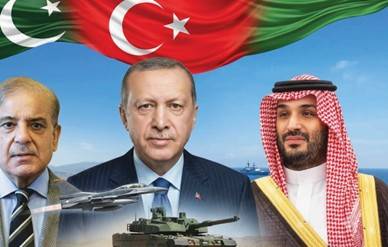
The military capabilities of the "Sunni NATO"
On a theoretical level, the combination of the three countries is particularly strong.
The military capabilities of the "Sunni NATO"
The mutual defense agreement signed by Saudi Arabia, Turkey, and Pakistan marks a significant shift in the way security is shaped in the Middle East and the wider Muslim world. Beyond the talk of an “Islamic NATO,” the Mecca Pact reveals a deeper geopolitical trend, as the three countries seek to strengthen their security guarantees at a time when the credibility of the American protective umbrella is being questioned. With different military, economic, and technological capabilities, the three countries seek to create a new deterrence network that is not directed exclusively against a specific adversary but reflects a broader rebalancing of the balance in the region. The question, however, is whether the agreement can be transformed from a strong political message into a real collective defense mechanism.
The importance of the Agreement
"Islamic NATO" was the expected "label" that several analysts were quick to apply to the signing of the Mutual Defense Pact between Saudi Arabia, Turkey and Pakistan. The Mecca Mutual Defense Pact provides that an armed attack against any of the three countries will be considered an attack against all three.
However, the comparison with NATO does not properly capture the significance of the agreement. Three countries that are partners of the United States have decided to link their security with each other, and the most important audience for this move is neither in Tehran nor in Tel Aviv, but in Washington. In essence, the agreement is a “challenge” on the credibility of the United States as a security guarantor.
In theory, the combination of the three countries is particularly powerful. Turkey has the second-largest army in NATO, as well as a drone industry that has changed the game on modern battlefields. Saudi Arabia has the largest economic reserves in the Persian Gulf, while Pakistan adds a large and experienced military force, as well as the only nuclear arsenal in the Muslim world. Experts point out that the capabilities of the three countries are largely complementary, since Turkish technology needs markets, Pakistani manpower needs financing, and Saudi wealth needs manpower.
In any case, the Pact did not come out of nowhere. It is an extension of the Saudi-Pakistani agreement of September 2025, which was signed a few days after the Israeli attack on Hamas targets in Doha, Qatar. The need for enhanced cooperation became even more urgent after the US-Israeli war against Iran, which broke out on February 28 and was followed by a series of attacks on Gulf countries.
For decades, the Gulf countries have been under the protective “umbrella” of the United States. The war with Iran, however, has brought back a question that the entire region would perhaps prefer never to ask: How reliable is the American umbrella, when American bases in the Gulf have failed to prevent Iranian attacks on facilities in Saudi Arabia and the United Arab Emirates, and when Washington has appeared visibly hesitant about how to respond?
The Mecca Pact is Riyadh’s response. It is essentially an insurance policy by governments that no longer want to trust their security to a single guarantor. This does not mean, however, that the three countries can replace the United States, which continues to play a central role in their security. Officials in the countries emphasize, moreover, that the agreement does not replace any of the existing bilateral or multilateral agreements. It is more about diversifying security guarantees than breaking with Washington.
The most significant cost for the US concerns the geopolitical balance in the region. Saudi Arabia’s inclusion in the Abraham Accords, aimed at normalizing its relations with Israel, is a key pillar of successive US administrations’ plans for the Middle East . With its connection to Ankara and Islamabad, two capitals that maintain an openly hostile stance towards Israel, Riyadh increases the political cost of any move towards normalization of relations and makes such a development more difficult, if not impossible.
Particularly striking is the element of self-undermining in American policy. In July, the US and Saudi Arabia signed an agreement allowing the kingdom to develop its own “peaceful” nuclear program . Trump, however, made it a condition that the program be linked to Saudi Arabia’s accession to the Abraham Accords . For many analysts, this condition “sounded an alarm in the Gulf,” as it created the impression that Washington could use the agreements as a means of exerting pressure.
Thus, a tool designed to bring Saudi Arabia closer to Israel may have ultimately pushed it towards Pakistan and Turkey. At the same time, Israel sees the deal as a particularly worrying consolidation of a hostile front, which now has a nuclear dimension.
Its importance in practice
However, the significance of the agreement should not be overstated. The text signed does not provide for specific military commitments, and whether it obliges the parties to take action in the event of an attack remains unclear. History has shown that neither the 2000 Saudi-Yemeni border agreement nor the 2025 Saudi-Pakistan bilateral treaty have led to anything approaching the implementation of NATO’s Article 5 , and neither has been activated in such a way.
The most dramatic interpretation of the Mecca Pact, that Pakistan provides a nuclear “umbrella” to the Gulf , is also the least substantive. Turkey already hosts American nuclear warheads, Saudi Arabia continues to seek cooperation with Washington on peaceful nuclear energy, and Pakistan’s nuclear arsenal remains geared toward deterrence against India. As such, the nuclear element of the agreement, as one analyst points out, has mainly symbolic and deterrent weight rather than the form of a formal guarantee.
For Pakistan, the deal is both an opportunity and an exposure to risks. It elevates Islamabad from a recipient of financial support from Gulf countries to a security provider with increased prestige, while offering industrial and diplomatic benefits. The collective defense clause, however, is as much a liability as an asset. It could embroil a country already facing pressure on its eastern and western borders in far-flung conflicts in the Gulf.
At the same time, there is a risk of undermining the mediating role that Islamabad has carefully built between Washington and Tehran . This was also evident from the memorandum of understanding signed in Islamabad on June 17, which achieved at least a degree of stabilization in hostilities in the US-Iran conflict.
Tehran has already dismissed the deal as “loan security,” a pointed reference that ignores its own reliance on proxy networks. Nevertheless, some more conservative voices in Iran see the deal as a form of Muslim ittihad, or union.
Experts explain that the real consequences of the Mecca Pact have not yet been tested and probably will not be tested soon. Its message, however, is clear. The era in which a single external power assumed the costs of security in the Middle East is fading and in its place is taking shape a more complex system , in which states themselves seek multiple guarantees and possibilities for self-protection.
Washington can either view the pact as a loss to be reversed or as a warning to be taken seriously.
The alliance's military capabilities
The agreement comes at a time when the three countries are struggling to manage rising regional tensions, including concerns about Israel's expanding military presence and influence, as well as Iran's regional role.
According to the Global Firepower 2026 index, which assesses the defense capabilities of 145 countries, the three countries have a total of nearly 1,4 million active military personnel, approximately 3.400 aircraft, 6.000 tanks, and more than 340 combat and support naval assets.
The index evaluates each country's potential military power on land, air and sea, taking into account factors such as human resources, military equipment, natural resources, economic data and geography.
In terms of manpower, the three countries have a combined total of about 1,4 million active military personnel, with significant additional reserves and paramilitary formations. Pakistan has the largest active military force, about 660.000, followed by Turkey with 481.000 and Saudi Arabia with 247.000.
In the air, the three countries have a total of 3.415 military aircraft, including fighter jets, helicopters, transports and training aircraft. Pakistan has about 1.397 aircraft, Turkey 1.101 and Saudi Arabia 917.
In terms of ground forces, the three countries have approximately 6.046 tanks and more than 179.000 armored vehicles, as well as thousands of artillery systems and multiple rocket launchers. Pakistan has the largest number of tanks, with 2.677, followed by Turkey with 2.284 and Saudi Arabia with 1.085.
At sea, the three countries' combined naval forces total 344 units, including 33 frigates, 24 corvettes and 22 submarines. Turkey has the largest naval force, with 192 units, followed by Pakistan with 120 and Saudi Arabia with 32.
The economic dimension of the agreement is also significant. The three countries have combined defense budgets of about $124,4 billion annually. Saudi Arabia is in first place, with defense spending of $63,9 billion for 2026, while Turkey has $51,4 billion and Pakistan $9,1 billion, according to Global Firepower.
SOURCE: TODAY