

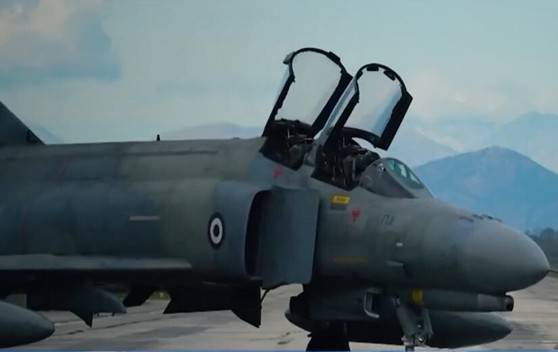
The correlation of Greek-Turkish weapons systems in 1974.
The correlation of Greek-Turkish weapons systems in 1974
 PAPPAS D. IOANNIS
The summer of 1974 remains the deepest, most open wound in modern Greek history . For decades, the debate surrounding the Cyprus tragedy has been trapped in emotional outbursts and anathemas. However, the central question returns tormentingly: Why did Constantine Karamanlis, during the second phase of the Turkish invasion (Attila II, 14-16 August 1974), choose military abstention, sealing the fate of the island with the painful realization that “Cyprus lies far away”?
Why, then, did he refuse to open the Cyprus File, and why did he never convincingly explain the main reason why he then “abandoned” Cyprus militarily? Those who approach history superficially simply count the numbers of aircraft and submarines. However, if one is transported to the dramatic foreground and background of those days, one realizes that Karamanlis’ decisions were not acts of cowardice . They were dictated by a perception of raw, painful realism. His basic position was that if he led Greece into war under the conditions of the time, he would not save Cyprus. On the contrary, it would most likely lead to national disaster.
Supporters of direct Greek military involvement base their reasoning on a theory of immediate strike. The argument states that the Air Force should and could, with the ultra-modern F-4E Phantoms it had received by the eve of Attila I, which the Turkish Air Force did not have at that time, strike the Turkish forces in Cyprus. At the same time, the advanced Greek submarines “Glaucos” and “Nireus” could sink the Turkish destroyers and landing craft, drowning the invasion on the coast of Kyrenia.
This is the apologetic narrative of the coup plotter Brigadier General Ioannides and the Junta Prime Minister Adamantios Androutsopoulos, as well as others who had no connection to the Junta. According to this school of thought, a war between two NATO members, which would follow immediately after Greece’s military counter-intervention in Cyprus, would not be allowed by the international community to last more than 48 to 72 hours.
The proponents of the intervention in Cyprus believed that the US, NATO and the UN would intervene fire-fighting to enforce a ceasefire. Therefore – always according to this school of thought – Greece simply needed a local, shocking blow to force Ankara to retreat in Cyprus, before the conflict became generalised. This approach, however, ignores the background of international balances and the real state of the Greek war machine.
The language of numbers and Cyprus
A comparison of weapons systems in the summer of 1974 revealed a large Turkish numerical superiority. The Turkish Air Force had a fleet of approximately 520 fighter aircraft, compared to 290 on the Greek side. In the basic types of the time, Turkey had twice as many flexible F-5s, while the hard core of its strike force was based on over 150 F-100 Super Sabres, a type that Greece did not have.
Greece's only qualitative advantage, the newly acquired F-4E Phantoms, were few. Of the total order of 38 aircraft, Greece had managed to receive 17. During the days of the crisis, their crews and ground engineers were still completing their training, while these aircraft had been delivered to the Hellenic Air Force with insufficient ammunition stocks for a multi-day war, such as Sparrow and Sidewinder air-to-air missiles, etc. (see Memo, Vice Adm. Pete to DepSecDef, subj: Status of F-4 Deliveries, 18 July 1974, folder Greece 1974, box 62, Acc 330-78-11).
For example, during the relocation of six of the F-4s from Andravida to Crete, with great delay, on 11 a.m. on July 22, 1974, 52 hours after the start of the Turkish invasion of Cyprus and just five (5) hours before the agreed truce (ceasefire), one aircraft caught fire and was destroyed upon landing on the runway. When it was discovered that there were no suitable bombs to load, the Greek staff considered that the solution was to proceed with an illegal “confiscation”: officers of the Hellenic Navy went to the American NATO warehouses at the Souda base and dropped Rockeye cluster bombs in order to equip four aircraft from that squadron.
This swarm could have dealt a first serious blow to the invading troops in Cyprus, but it could not have repeated it in the following hours and days, because, on the one hand, the agreed ceasefire was imminent in a few hours, at 4 p.m. on July 22, 1974, and on the other hand, the Greek break-in to the American NATO warehouses in Crete could not have been repeated.
Given that their ammunition was stolen, the US Sixth Fleet had the legal right to intercept or even shoot them down on their way to Cyprus. But even if they finally managed to reach Cyprus for the one and only time, they would only be able to remain in its airspace for 5 minutes, so that they could return to Crete.
The problem of geography
That is, another critical problem was geography. The Turkish bases in Adana were a few minutes’ flight from Cyprus, allowing Turkish fighters to operate for hours over the island. In contrast, the Greek bases in Crete were over 500 km away. The Greek F-5 and F-104 did not have the range to reach Cyprus, engage in dogfights, and return without aerial refueling — a technology that Greece did not have at the time. Only a relatively small number of Phantom F-4s could operate in Cyprus, but with the above serious limitations at the time.
The same was true for both submarines: they would be within firing distance of the Turkish landing forces just 2-3 hours before the agreed ceasefire, making Greece appear to be escalating the war just before the armistice, potentially providing Turkey with a pretext to even occupy the whole of Cyprus.
Those amateurish actions of the Armed Forces Headquarters at that time, with delayed advances and withdrawals of weapons systems on the Crete-Cyprus axis, were indicative of the criminal surprise suffered by the Greek General Staff by the Turkish landing in Cyprus. On July 22, 1974, it was too late for Cyprus and Greece, as they were both heading towards the ceasefire agreed upon since the morning (9-10 a.m.) of July 22 at 4 p.m., as a result of the ultimatum-demand of the USA to Greece and Turkey late in the afternoon of July 21 that both accept a ceasefire within a 12-hour period ( OSD, Secretaries of Defense Historical Series, vol. 8, ch. 7, p. 6 ).
A decisive, but unspoken parameter of the crisis, was the stance of the US and Kissinger. Many historical articles report that the US embargo was imposed on Turkey. This is true for 1975, when Congress reacted retrospectively. However, in the summer of 1974, from July 18, 1974, that is, on the eve of Attila I, Washington imposed a unilateral informal suspension of the supply of arms and ammunition embargo exclusively against Greece. Three days after the criminal coup against Makarios, Kissinger implemented an informal “freeze” of all military aid and delivery of military equipment to Greece as an aggressor country.
The episode in Rota
The most striking evidence of this biased attitude unfolded at the American base in Rota, Spain. There, two brand new Greek Phantoms, flying from the US factory to Andravida, were grounded on Kissinger’s personal orders from July 18, 1974. America banned their takeoff, depriving the Air Force of two valuable weapons at a time when it needed them most. The suspension of American aid and military supplies to Greece was leaked from the Pentagon and published in the Washington Post on Monday, July 21, 1974.
According to journalist Michael Getler, the US government " ordered the temporary suspension of all military aid to Greece ". It is worth noting that at the time there was a disagreement between Kissinger and Secretary of Defense James Schlesinger regarding the interruption of military supplies to Greece only, as the former argued, or to both the opposing countries, Greece and Turkey, as the latter argued. Ultimately, Kissinger's view prevailed.
This unilateral “embargo” meant that Greece risked being deprived – in the event of an escalation into a Greco-Turkish war – of crucial spare parts and modern ammunition. In contrast, Turkey enjoyed the tolerance of the White House. The Turkish invasion forces used massively (and with impunity) American aircraft, tanks and ammunition, with their supply lines from the US remaining open. Under those circumstances, if Greece chose to generalize the war, its logistical endurance would not exceed a few days, if the American embargo continued. As soon as the first warehouses were emptied, the Greek defense would collapse from a lack of missiles and spare parts, while Turkey would replenish.
The theory of local deterrence, namely the intervention of the squadron of six Phantom F-4s and the two submarines in Cyprus, was based on the arbitrary assumption that a generalised war between Greece and Turkey would last two to three days, while Turkey under those circumstances had every interest in prolonging a generalised war. In all likelihood, Turkey would prolong it, given the determination of the Turkish leadership on the Cyprus issue.
This determination was steely, as it turned out:
- From their premeditated decision to accept up to 50% losses of the disembarking Turkish troops.
- On the field, from the forces that had managed to land in Cyprus by 27 July 1974, namely 18.000-22.000 soldiers and 70-80 tanks (Information Paper, “Chronology of Cyprus Crisis,” 31 Jul 1974, folder Cyprus 0001, Jan-Jul 1974, box 61, Acc 330-78-0011), as well as later.
- From their three-year absolute refusal to make any concessions on the Cyprus issue despite the embargo on military supplies imposed on them in 1975-1978 by the US Congress.