

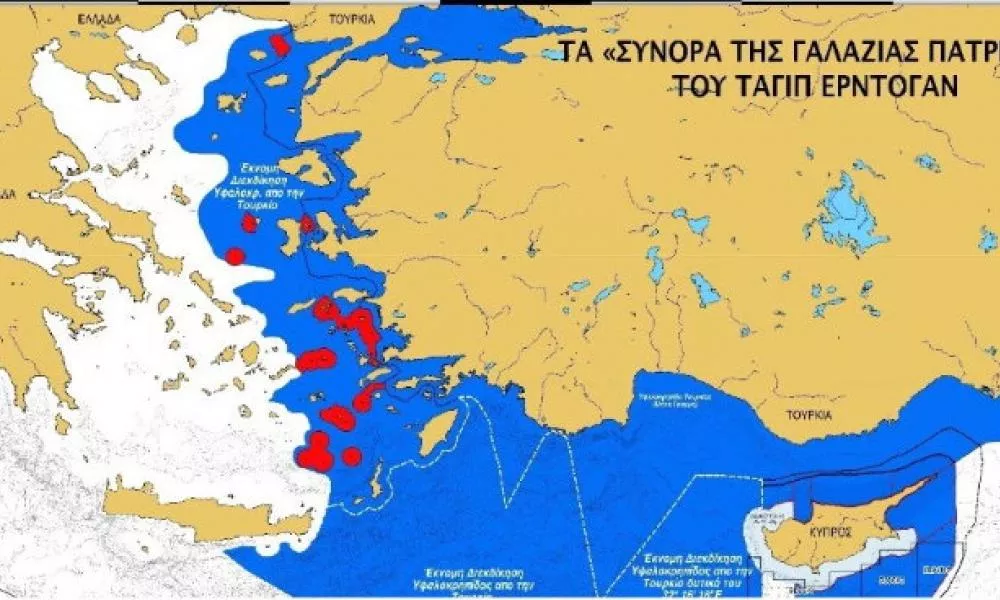
Baltzoi: Turkish parks are part of the "Blue Homeland"
Baltzoi: Turkish parks are part of the "Blue Homeland"
https://www.youtube.com/watch?v=Oh3dtVZU-HQ&t=932s
Lieutenant General (retd) Ioannis Baltzoi intervenes on "Naftemporiki" television and warns about the strategy followed by Turkey in the Aegean and the Eastern Mediterranean.
Published on August 18, 2026 at 11:00
Lieutenant General (retd.) Ioannis Baltzoi, speaking on "Naftemporiki" television, took a particularly stern tone regarding the Greek stance towards the escalating Turkish strategy. The focus of his intervention was on the Turkish marine parks, the "Blue Homeland", the need for deterrence, and the new Turkey-Saudi Arabia-Pakistan agreement, which he described as a potentially dangerous military axis.
Ioannis Baltzoi argued that Ankara's move with the marine parks should not be examined in isolation. In his assessment, it is yet another episode of a broader and long-term Turkish strategy to the detriment of Greek sovereign rights.
"The marine parks […] are the last small episode of a more general strategy by the Turks," he said, while also harshly criticizing the way Athens is reacting.
"We are supposed to be guarding Thermopylae – In reality we are sleeping"
The most characteristic aversion to his intervention concerned the Greek reaction.
"We're not just sleeping. I would say we're also sleeping standing up," said the lieutenant general, adding: "We're supposed to be standing up and guarding Thermopylae. In reality, we're sleeping and not reacting."
He directly linked the marine parks to the "Blue Homeland" doctrine, assessing that Turkey is gradually attempting to turn its unilateral claims into a political and legal reality.
According to his analysis, the location of the two Turkish parks is not accidental. He placed particular emphasis on the area between Lemnos and Thassos, but also in the Eastern Mediterranean, arguing that the Turkish design attempts to limit the influence of the Greek islands and especially the Kastellorizo complex.
Baltzoi stressed that Ankara treats the Greek islands as if they only have rights up to six nautical miles, while attempting to calculate maritime zones based on the continental coasts.
"He's testing us - He knows we won't react"
He gave particular importance to the deterrent dimension of the Turkish strategy. In his assessment, Ankara is not simply creating faits accomplis, but is also measuring Greek reactions.
"He's testing our reactions," he noted and assessed: "He knows. We won't react. If we did react, they wouldn't do it."
He even used the example of Israel to describe how he himself understands real deterrence: not simply with an equivalent response, but with the prospect of creating a "multiple fait accompli" in the event of a provocation.
The retired lieutenant general appeared particularly critical of the practice of diplomatic announcements on international law, believing that they alone are not enough to intercept a fait accompli strategy.
In his view, Greece should send a much clearer message to Turkey, the EU, NATO and the US that in the event of actions that violate Greek rights, Athens will use all the means provided to it by international law.
He even went so far as to request that "military involvement" not be rhetorically ruled out as an element of the deterrent strategy.
"Say this word, military involvement," he said, pointing out that Turkey has formulated the casus belli against Greece, while the Greek side is avoiding similarly strong deterrent messages.
The new Turkey-Saudi Arabia-Pakistan axis
The second major part of the intervention concerned the agreement between Turkey, Saudi Arabia and Pakistan.
Baltzoi advised against panic, but clarified that developments require careful monitoring.
He described the new formation as a "Sunni arc" and as a form of "small Islamic NATO", clarifying, however, that it does not have the structures of the North Atlantic Alliance.
According to him, its geopolitical importance arises from the combination of the capabilities of the three states:
"Turkey has the army, Saudi Arabia has the money and Pakistan has the nukes."
The lieutenant general described this combination as militarily "dangerous", presenting data on the manpower, aircraft, tanks, naval units and defense budgets of the three countries.
According to the data he cited, the three countries have approximately 1,4 million active military personnel, more than 3.400 aircraft and a total defense budget of more than $124 billion annually.
Egypt and the Greece-Cyprus-Israel axis
Baltzoi estimated that, for the time being, Egypt does not seem to be part of this specific scheme, without however ruling out future changes.
"We don't know what the Turks will promise," he warned.
At the same time, he linked the developments to the broader geopolitical network of Greece, Cyprus and Israel, also referring to a larger cooperation scheme in which India and the United Arab Emirates could participate, with Egypt constituting a critical potential link.
According to him, the Turkey-Saudi Arabia-Pakistan trilateral now creates a clear strategic basis for existing partnerships in the Eastern Mediterranean.
"IMEC is not in danger"
He also made special reference to the IMEC economic corridor, rejecting estimates that the new agreement automatically leads to its cancellation.
"IMEC is not in danger," he stressed, explaining that the corridor is also in the interests of Saudi Arabia and that geopolitical agreements do not mean that the participants abandon all their other collaborations.
In the broader international context, Ioannis Baltzoi also referred to the US-China competition, arguing that energy and the control of energy flows are a key parameter of the US-China confrontation.
He spoke of the prospect of a "new Yalta," that is, a broader settlement between the great powers, in which China should eventually participate.
The central warning of his intervention, however, concerned Greece: in his assessment, Turkey is implementing a methodical strategy of gradual faits accomplis, knowing that the Greek reaction will generally be limited to the diplomatic level. And it is precisely this belief of Ankara, according to the lieutenant general, that constitutes the most serious problem for Greek deterrence.