

The bloody Resurrection of a non-existent God
Subject: book review
“Grabbing the expected historical book in my hands, I automatically remembered that every year anniversary events are organized in the Holy City of Messolonghi, and the President of the Republic is always present. Of course, the title “Holy City” was attributed to Messolonghi because it was identified more than any other region with the Liberation Struggle of 1821.
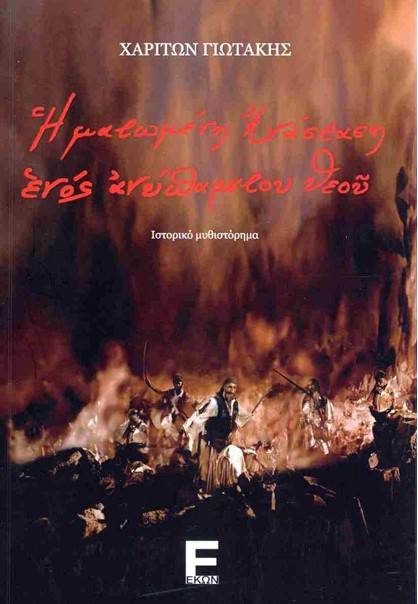
The author was obviously moved by the enormous sacrifice of the besieged fighters and chose to highlight the history of the Holy City. Thus begins my interest in Chariton Giotakis' book "The Bloody Resurrection of a Non-Existent God" from "Ekon" publications 2024.
The first impression is awe-inspiring from the appearance of the cover and then the large number of pages (936). The publication is very well-edited, the paper and cover are the most appropriate for a product of this size, and the binding on the spine of the book is durable.
Looking at the book, I wondered how long it would take to read and at what pace, and how large it might have been originally and reduced so that it could be published in one volume! Starting – necessarily at a slow pace – and bearing in mind the author's literary pen from his previous books, I was pleased to find that it is his most complete work in every respect.
As unusual as it may seem, I was concerned about when I would be able to finish it – since I had to interrupt my reading at times – without losing the progression of the text and the coherence of the repeatedly unfolding events. However, it helped that it was divided into many chapters with simple numbering.
The text, in literary terms, distinguishes the unique technique, the rich and expressive linguistic wealth with which the author expresses himself, the exceptional and vivid illustrative narratives at every step, which come as close as possible to the events of the era.
Throughout the text, the enormous effort of the author's preparation is absolutely evident, regarding the acquisition of specialized knowledge of a huge volume, drawing multiple elements from the sources, and from a multitude of studies and scientific theses. The text is governed by the spirit and linguistic idiom of the era, since special terminology and vernacular were used (an extremely difficult undertaking, which has been attempted by few writers and had the desired result by very few!). The author provides detailed information on the place names and equipment – exactly as it was at that time – which is presented with absolute fidelity, giving the reader as an aid, where necessary, the corresponding extensive and very comprehensive footnote references. Together with the multitude of sources and studies listed in the last pages of the book, it can be characterized as a scientific work!
The author preferred not to have photographs, sketches, and maps, and so I looked for a local map of the time with the individual small locations and islands of the lagoon, as I deemed it necessary to distinguish the distances between them during the constant hikes, like an index so as not to lose track.
An aristocratic “bon viveur” of the time was cleverly chosen as the protagonist, who nevertheless spent his entire life on the various battlefields of Europe. He is a prominent figure who, from a little archival research I did, seems to have existed, in a way, as a real person, but surrounded by some elements that constitute “literary license”. We follow him on his blood-soaked journey, where historical figures appear everywhere in their real roles.
Continuing, I became so absorbed that I felt strongly that I had "been transported and living" in the repeatedly besieged Messolonghi with its lagoon and islets.
I also noticed in this work the layered sequence and logical continuity of expression throughout, an admittedly heroic drama. Everywhere the patriotism of the trapped and besieged fighters emerges and flows, many of whom were not residents, but went to participate in a predetermined historical outcome. The text inevitably leads you to many emotions. Some of which are the awe for the agony and perseverance of the fighters, the self-denial in the face of all hardships, the love that can be born even in such a situation, the horror of the losses and finally the tragedy and psychopathology of merciless hunger!
And the pages never end, with the feeling that the author wants to "give us everything", not daring to omit details that could "offend the Epic of Heroes".
I was impressed by the handling and expression of the psychological dimension of the besieged, in order to cope with the ongoing struggle through all the unbearable deprivations, since they are presented in great detail, constituting special psychographs of the personality of these warriors.
The battle scenes, as always, are the author's trademark, literally taking your breath away and giving the feeling that you are watching a movie!
From a certain point in the book onwards, you think that all the characters are protagonists since they acquire dominant roles.
The author rightly refers to and compares the besieged with their ancient ancestors. The fighters of 1821, although they knew very little literature, were nevertheless historically informed about the actions of the Greeks at Thermopylae, Marathon, Salamis and elsewhere, feeling that they could not lag behind them. In this book they are presented as having (and indeed did have in reality) very strong strength, and as being themselves descendants, fighters for the life and continuation of History, writing new pages in the book of the Greek Nation!
The description of the last phase of the siege is fascinating, which deprived the besieged, without the possibility of replenishment, of the necessary food, water, medicine and ammunition. However, the mental and moral reserves from the ongoing and suffocating and merciless siege remained inexhaustible, while the tragic end was clearly visible, a fact that became clear through the text.
This work, faithfully following historical conclusions, delivers with absolute realism scenes of horror, anguish and despair, but also the above all need for the survival of the besieged city.
I would describe the emotional and psychological descriptions of the besieged fighters as excellent and very graphic.
Completing the study of the book, it is found that the writing result is clearly impressive and magnificent. Throughout the entire journey there is the sequential historical development. It may be a historical novel, but it fully follows the historical events on every page, with details for every movement and action.
The author edits each page, using terminology, topography, urban planning and everything related to the geophysical terrain of the business area.
As mentioned above, it is not easy for unfamiliar readers to read, due to the author's use of perfect and rich Greek language, scientific historical descriptions and the abundance of interpretations and clarifications. Therefore, the prospective reader should not be deterred by the size of the book - it is not recommended for reading on the beach and on vacation! Careful study of each chapter is required, as it is a highly successful and historically thorough work.
The emotions that flow from reading are rich and torrential, highlighting the special and charismatic writing talent of Chariton Giotakis. As a historical researcher himself, and having written other historical novels, he follows the same scientifically rigorous methodology. He gathers all the historical sources, cross-references the assessments from studies and theses and chooses the truth. Through his own literary and interpretative framework, he responds worthily to the mission of his book. Both the writing and the extremely well-edited edition deserve many congratulations!”
George Sideris.