

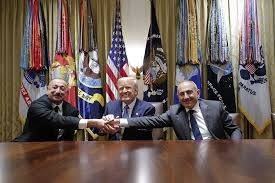
The deal that didn't happen.
Armenia and Azerbaijan didn't actually sign a peace treaty at the White House. So why did their leaders say Trump deserves the Nobel Peace Prize?
Source: Meduza
The meeting between Azerbaijani President Ilham Aliyev and Armenian Prime Minister Nikol Pashinyan in Washington on August 8 sparked a wave of celebrations. The White House called it historic, and Western media outlets were quick to report that, thanks to the mediation of US President Donald Trump, a decades-long conflict had finally come to an end. Aliyev and Pashinyan even went so far as to say that Trump deserved the Nobel Peace Prize. But the truth — incredible as it may seem — is more complicated. For Meduza, Caucasus expert Roman Chernikov explains what really happened at the White House summit and what issues still remain to be resolved between the two countries.
Little more than a photo opportunity
The day before Friday’s summit in Washington, Donald Trump wrote a misleading post on his platform, Truth Social, calling the meeting an “official Peace Signing Ceremony.” Major international news organizations like the Associated Press, CNBC, and Euronews were quick to reproduce this wording. In reality, however, the two sides only signed a declaration containing a simple and rather self-explanatory seven-paragraph statement.
The first point states:
We and the President of the United States of America, Donald J. Trump, witnessed the initial signing of the agreed text of the Agreement on the Establishment of Peace and Interstate Relations between the Republic of Azerbaijan and the Republic of Armenia by the Ministers of Foreign Affairs of the Parties. In this context, we recognized the need to continue further actions to achieve the signing and final ratification of the Agreement and stressed the importance of maintaining and strengthening peace between our two countries.
The two leaders then initialed the peace treaty, which contains 17 points, to show that they agree with the text and will not seek changes to the wording. However, they have not yet signed it. (The text of the document was not made public until three days later, on August 11.)
Negotiations on the text of the treaty have been underway since 2020, with the participation of Russia, the European Union and the United States. At one point, there was even talk of two separate versions of the agreement. However, the final text was agreed between the two sides, without mediators, in March, when Armenia accepted the last two disputed points.
As a result, the White House event was essentially a purely ceremonial gesture — since the foreign ministers of the two countries had already deemed the document ready five months earlier. When the heads of state will sign it remains unknown.
If this wasn't a peace treaty signing, why were Aliyev and Pashinyan celebrating Trump?
For Yerevan and Baku, maintaining good relations with Trump is important — so that, in the event of a resurgence of tension, they can turn to him and accuse the other side of violating the terms of the agreement. This is especially critical for Armenia, which is in a weaker position. Trump’s belief that the conflict in the South Caucasus is over acts as a kind of insurance for Yerevan against a new war, at least for the next three years, until the next presidential election in the United States.
What needs to be done for the countries to finally sign the real peace treaty?
Azerbaijan has two demands from Yerevan from which it has never backed down: the dissolution of the OSCE Minsk Group, which has been mediating the conflict since 1992, and the amendment of the Armenian Constitution, which, according to Baku, contains territorial claims.
So far, progress has been made only on the first request. Among other documents signed in Washington, there was a joint appeal by Armenia and Azerbaijan to the OSCE, calling for the dissolution of the Minsk Group now that the conflict is considered over. But that is not enough — the final decision will be put to a vote by OSCE foreign ministers at their meeting in Vienna on December 4–5. There is little doubt that the vote will pass.
The situation with the Armenian Constitution is more complicated. Nikol Pashinyan has repeatedly changed his position — sometimes announcing a referendum on the Constitution in 2027, sometimes saying that no changes are needed.
In late May, Pashinyan even proposed adding an additional stage of verification to the peace agreement:
If the Constitutional Court decides that the text of the peace agreement between Armenia and Azerbaijan conflicts with our Constitution, I will initiate constitutional amendments, because this peace process and the agreement must not be abandoned. We will try to convince our society to make these changes, so that we can achieve a stable and lasting peace.
This rhetoric is mostly populist. Submitting a draft peace treaty to the Constitutional Court is certainly possible, but it will hardly convince Azerbaijan’s Aliyev. Most likely, Pashinyan will need to amend the Constitution anyway — but he will move in this direction only after the parliamentary elections in June 2026, so as not to damage his popularity.
Pashinyan’s re-election campaign will likely be based on the claim that his chosen diplomatic path has brought the country as close as possible to signing a peace treaty and securing security guarantees from the most powerful country in the world — the United States. But, to complete the task, he will argue, Armenians must give him another term. Only then will the Armenian authorities be able to proceed with all the unpopular measures (such as border demarcation) and prepare for the referendum.
Will the peace treaty include Armenia's complete renunciation of Karabakh?
Yes. The treaty states that both countries confirm that “the borders between the Soviet Socialist Republics of the former USSR became the international borders of the respective independent states” and respect each other’s territorial integrity. This means that Karabakh is officially Azerbaijani territory.
Previous drafts of the treaty included rights for Armenian residents of Karabakh, but that was before September 2023 (when Armenia lost control of Karabakh). In addition, Azerbaijan insisted on including a right of return for Azerbaijanis expelled from Armenia at the beginning of the conflict in the late 1980s and early 1990s.
Another big issue for Armenian society is the fate of Armenian prisoners held in Baku, including former Karabakh leaders and ordinary soldiers, whom Azerbaijan refuses to recognize as prisoners of war because they were captured after November 9, 2020. However, the peace treaty does not guarantee their release — Baku wants to keep this issue for the future as a political bargaining chip.
What is the "Trump Route" everyone is talking about?
This is the new name used for the “Zangezur corridor” — a proposed highway connecting mainland Azerbaijan with the Nakhchivan enclave through Armenian territory. Although its opening is not mentioned in the peace treaty (the issue caused so much controversy that it was eventually omitted), Baku has made it clear that it has no intention of abandoning the idea.
It was the Trump administration that put forward a proposal that seemed to satisfy both Baku and Yerevan. The details remain unclear, but the basic idea is that an American company would manage the Armenian section of the road. The official name of the project is as grandiose as it gets: Trump Road for International Peace and Prosperity ( TRIPP ).
The details are likely set out in a separate document signed the same day between Yerevan and Washington — the “Memorandum of Understanding between the Government of the Republic of Armenia and the Government of the United States of America on Partnership in the Field of Capacity Development of the “Crossroads of Peace” Project.”
The full text has not yet been made public, but the basic demands from each side have been known for some time. Baku insists that traffic along the road should be “unhindered” (a word that appears in the tripartite declaration), while Yerevan argues that it cannot be called a “corridor” and that the road should operate under Armenian law and with respect for the country’s national sovereignty. How these conflicting points will be resolved remains an open question.
What does Moscow think about the agreement?
There is no doubt that this agreement is a sign of Russia’s declining influence in the South Caucasus — especially when it comes to transport links. After 2020, a commission that included Russian Deputy Prime Minister Alexei Overchuk was responsible for reopening the roads, and the 2020 agreement that ended the Second Nagorno-Karabakh War explicitly stated that Russian border guards would control the “Zangezur corridor.” But as early as last fall, officials in Yerevan were saying that the commission had effectively stopped functioning “due to a lack of consensus.”
However, Russian border guards still play a role in the region, continuing to patrol the Armenia-Iran border (although they no longer check documents at the Agarak border crossing). This means they will have to find a way to coexist with any American presence in the region. Relations with Trump are important not only for Yerevan and Baku, but also for Moscow, which is why Russia has refrained from criticizing the “peace summit” in Washington.
“The meeting of the leaders of the South Caucasus in Washington, mediated by the American side, deserves a positive assessment. We hope that this step will help advance the peace agenda,” said Russian Foreign Ministry spokeswoman Maria Zakharova. This is not surprising — Moscow’s real influence in the region had already been lost by 2023, when the Armenians withdrew from Karabakh.
Whether Russia will be able to use the so-called “Trump Route” for rail connections with Turkey and Iran remains an open question. Nikol Pashinyan himself has already assured Moscow that this remains a possibility.
And Iran? Will it really accept the “Trump Roadmap” on its borders?
Iran’s reaction to the news from Washington has been its harshest yet. Ali Akbar Velayati, an adviser to Iran’s Supreme Leader, said Iranian territory could continue to be used to connect mainland Azerbaijan with Nakhchivan and added that he would oppose the creation of the “Trump Route,” whether Russia is involved or not. “NATO wants to wedge itself between Russia and Iran like a viper, but Iran will not allow it,” he said.
It is worth noting that an Iranian company is currently building a road in the Syunik province of Armenia, aiming to connect the north and south of the country. This means that sooner or later, Iranian builders will face off against the American company that will manage the Trump Road (their routes are almost perpendicular). How these roads will intersect will pose a significant engineering and political challenge.