

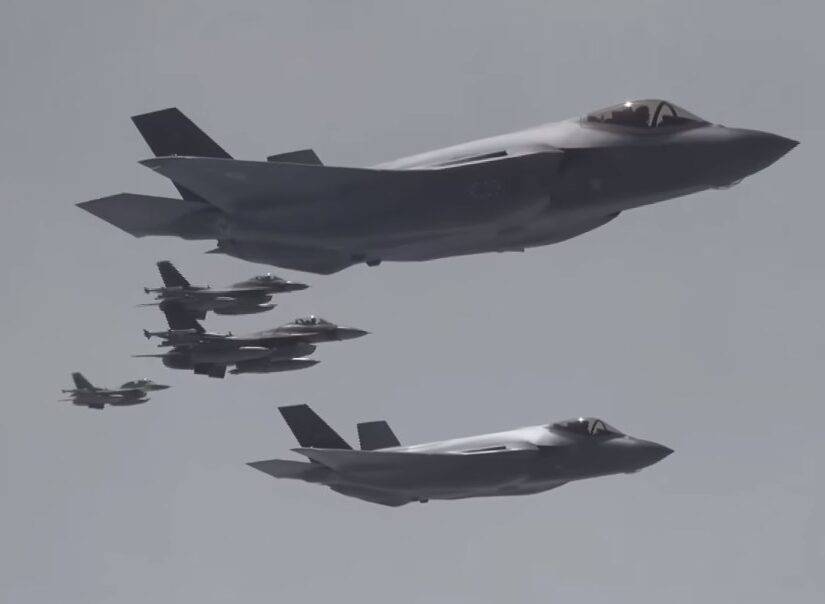
Why does the US Air Force have over 100 F-35s in storage?
 TSILIOPOULOS EFTHYMIOS
The US Air Force has been refusing to receive over 100 F-35 aircraft delivered by the company for nine months due to software problems, even though the Pentagon approved the fighter jet a month and a half ago.
Specifically, on March 12, U.S. Deputy Secretary of Defense William LaPlante announced the long-awaited Milestone C decision in the F-35 JSF program, which allows the start of full production (FRP) of these aircraft. The Milestone C decision in the F-35 JSF program was announced after reviewing the results of the operational test and evaluation (IOT&E), which also included the operational testing of the 30P06 and 30P07 software for the Block version. One of the concerns that arose is the continued improvement of the test infrastructure to ensure Block 4 capabilities (this includes the timely delivery of successive aircraft versions).
And here's the problem, as it's been nine months since the Pentagon stopped taking delivery of new F-35s. On April 15, the program received international approval to resume deliveries of the fighters, provided their software upgrade had progressed. That could happen as early as July, but a ready-made version of the software won't be available for another 12 to 16 months, the program's head told U.S. lawmakers.
Suspension of F-35 deliveries
In July 2023, the Pentagon refused to accept deliveries of new F-35s from Lockheed Martin, citing software issues with Technology Refresh-3, which would give the aircraft the extra computing power needed for improvements to sensors and weapons in Block 4. The new technology was supposed to be released last April, but has been delayed multiple times. The Pentagon doesn't know when it will be fully ready.
“ I’m as disappointed as you are that I can’t set a specific date and be extremely clear about exactly when we’re going to deliver ,” F-35 program executive officer Lt. Gen. Michael Schmidt told lawmakers during a hearing of the House Armed Services subcommittee. The “best chance the program has is to receive fighters before TR-3 is fully completed ,” Schmidt said. Under this “abbreviated” plan, the Pentagon would receive aircraft loaded with an interim version of the TR-3 software.
The group that directs the program, the Joint Strike Fighter Executive Steering Board , which is made up of representatives from the U.S. and international F-35 partners, agreed. “This version will have a ‘stable’ and ‘capable’ code for use in training, but full combat capability will not arrive for another 12 to 16 months,” said Rep. Rob Whitman, the subcommittee chairman. Schmidt accepted the timeline. Officials argue that the interim software release is better than nothing and will “save” undelivered aircraft from the wear and tear of not being used, as they would have been in storage for a long time, waiting for the TR-3 upgrade.
Schmidt did not say how many of the aircraft are in storage, but he said it is a “ significant number .” In January, Lockheed Martin officials said the number could be as high as 100 to 120 aircraft. In a best-case scenario, Schmidt noted, the Pentagon could begin fielding aircraft with the first software version in July. However, he also pointed to estimates from an independent review team that pushed the timeline back to August or September.
“ Future risks depend on whether TR-3 will require additional incremental software releases to test and implement critical fixes. If the risk manifests itself in laboratories or flight tests, TR-3 may require additional software releases ,” Schmidt stressed in his testimony. The problems with TR-3 do not affect jets already in the U.S. Air Force’s arsenal.
The brake of “synchronization”
The F-35 program has faced a number of development problems, mainly due to excessive “synchronization,” a neologism coined by program managers. Program managers want to change this framework for developing and acquiring the aircraft, with a plan to “ reimagine ” Block 4, defining its “ absolutely necessary ” capabilities. Through the “Reimagined Block 4,” the program will present a plan for delivering upgrades on a relative schedule, with the ultimate goal of reaching “combat-level” capability, with a subset of planned capabilities.
“ The Reimagined Block 4 will likely include common capabilities for electronic warfare, communications, navigation and reconnaissance, support and new weapons, as well as capabilities unique to U.S. services and other user nations .” Complexity, that is, is being built back into the program, rather than being cut. Under congressional guidance, the Pentagon will formally make Block 4 a stand-alone subprogram within the next year, Schmidt said.
So far, about 1000 aircraft have been delivered to 10 countries, which, according to data from last January, have flown more than 768.000 hours. The aircraft currently operate from 31 air bases, with more than 2.250 pilots and 15.125 suitably trained technical personnel. Recently, the F-35A variant was certified for combat use with the modern B61-12 nuclear bombs.
Source:https://slpress.gr/amyna/giati-i-amerikaniki-aeroporia-exei-se-apothikefsi-pano-apo-100-f-35