

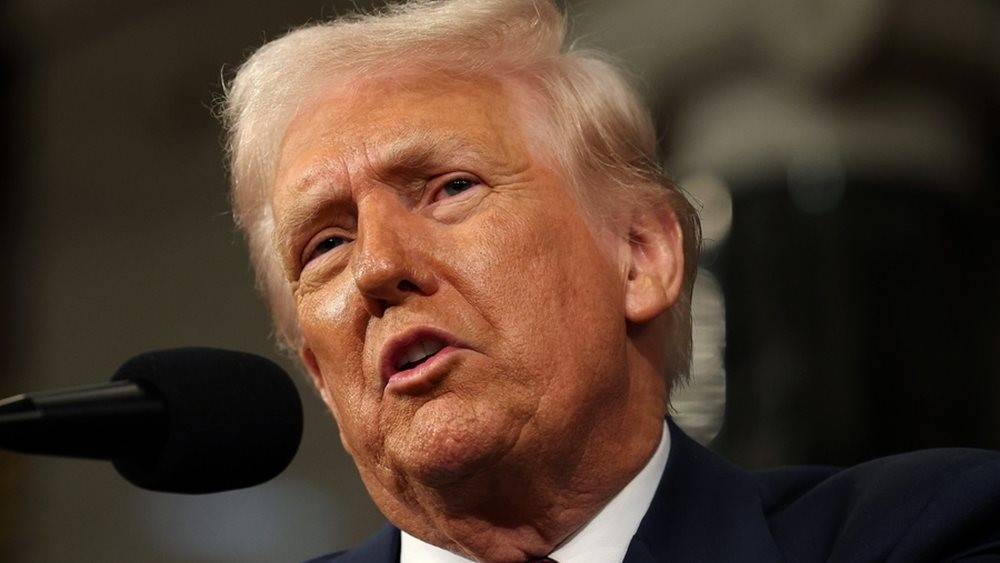
Trump is copying Nixon's strategy for Russia and China.
By Temur Umarov
The Trump administration believes that closer ties with Moscow will distract Russia from China, which it sees as the real existential threat to the United States. A former US president – Richard Nixon – had a similar plan in the early 1970s. The only difference is that Nixon’s plan was supposed to work in reverse: improving relations with China to isolate the Soviet Union. Back then, the US strategy worked – more or less. However, Donald Trump’s modern-day imitation of Nixon is unlikely to succeed.
“The greatest honor that history can bestow is the title of peacemaker. That honor now calls upon America,” Nixon said in his inaugural address in 1969. Trump has made no secret of his admiration for Nixon, nor his desire to go down in history as a peacemaker.
This imitation of Nixon is not limited to rhetoric. Nixon sent a secret mission to Beijing, led by national security adviser Henry Kissinger; Trump secretly sent his special envoy, Steve Witkoff, to Moscow to negotiate a prisoner exchange. Nixon allowed China to return to full membership in the United Nations despite ideological differences. Trump has begun to restore diplomatic relations with Russia. Just as Nixon sought to work with Beijing, Trump wants to work with Moscow.
Indeed, the prognosis for Trump is worse than that of Nixon in the 1970s. The architect of the US-China rapprochement, Kissinger, said then that both Washington and Beijing were interested in containing the Soviet Union. The same is not true today. Russia is extremely unlikely to want to contain China—they have too much in common.
Unlike the situation in the early 1970s, when it was preceded by a decade and a half of rising tensions between Moscow and Beijing, today’s relationship between Moscow and Beijing is based on the solid foundations of a long-standing shared border, complementary economies, and similar political regimes. These foundations are reinforced by the good personal relationship between Russian President Vladimir Putin and his Chinese counterpart Xi Jinping. While it is true that Russia and China do not call themselves “allies,” they certainly will not pick a fight with each other.
Indeed, the good relations between Moscow and Beijing at the moment are, to a large extent, the result of a shared hostility towards Washington. US sanctions against Russia and trade restrictions on China have brought the two countries closer together, both ideologically and economically. Their trade turnover is approaching $250 billion a year; Russia shares advanced military technology with China, and China sells Russia dual-use goods essential for its war in Ukraine. Even in Central Asia, where the two countries’ interests overlap, Moscow and Beijing cooperate closely.
Moreover, Trump cannot offer Russia anything comparable to what Nixon gave China. In the late 1960s, Beijing was facing serious economic problems due to its break with Moscow, and the warming of relations with the United States opened up a whole new horizon of opportunities (marking the beginning of the so-called Chinese economic miracle).
The Russian economy today is very different: it was and remains largely an integral part of the global system. This is why Western sanctions have not been as effective as their architects hoped.
Also, the economies of Russia and the US do not have much to offer each other (there was little overlap even before the full-scale invasion of Ukraine), unlike the economies of the US and China in the 1970s, which complemented each other.
There is also no political basis for Trump to build better relations with Russia. Before Nixon came to power, Beijing was isolated and was able to return to the global community thanks to Washington. Today, Russia is deeply disillusioned with the very concept of global integration under what it sees as “Western norms.” Trump’s idea of allowing Russia to return to the G7 group of advanced economies was seen by Russian officials as almost meaningless. The truth is that Moscow is happy not to participate in Western institutional frameworks, preferring to take a leading role in groups such as the Shanghai Cooperation Organization (SCO) and the BRICS.
Any attempt to pit China and Russia against each other will likely backfire. In Moscow, Trump is seen as an anomaly for the American establishment, from whom it might be possible to extract some short-term benefits but around whom it would be foolish to design a long-term foreign policy pivot. In both Moscow and Beijing, Trump’s actions are seen as proof that it is impossible to reach any agreement with Western leaders who are entrenched in their own short-term electoral cycles: in four years, when his term ends, Trump will no longer be president—but Putin and Xi Jinping still intend to remain in power.
The only reason Trump seems to have enjoyed any success in his attempt to build ties with Moscow in recent weeks is because he started from a very low point. A phone call with Putin is seen as a major step forward. But as time goes on, the contrast with his predecessor, Joe Biden, will become less apparent—and there will be fewer easy wins.
Trump is driven by his business instincts, not by the pursuit of geopolitical advantage. These instincts suggest that Russia would agree to make strategic concessions (such as abandoning its relationship with China) for significant economic gains. However, if that is what American officials expect, then they are deeply mistaken. They seem to have forgotten that Putin was prepared to sacrifice Russia’s economic development on the altar of his geopolitical ambitions when he launched a full-scale invasion of Ukraine.
The Kremlin will likely play Trump’s game: at the very least, increased attention from Washington strengthens Moscow’s position vis-à-vis Beijing. But it is highly unlikely that Moscow will make serious concessions. No matter how hard he tries, Trump will not be able to implement the same strategy with Russia that Nixon managed with China.
https://www.capital.gr/carnegieeurope-eu/3907283/o-tramp-antigrafei-ti-stratigiki-nixon-gia-rosia-kai-kina/