

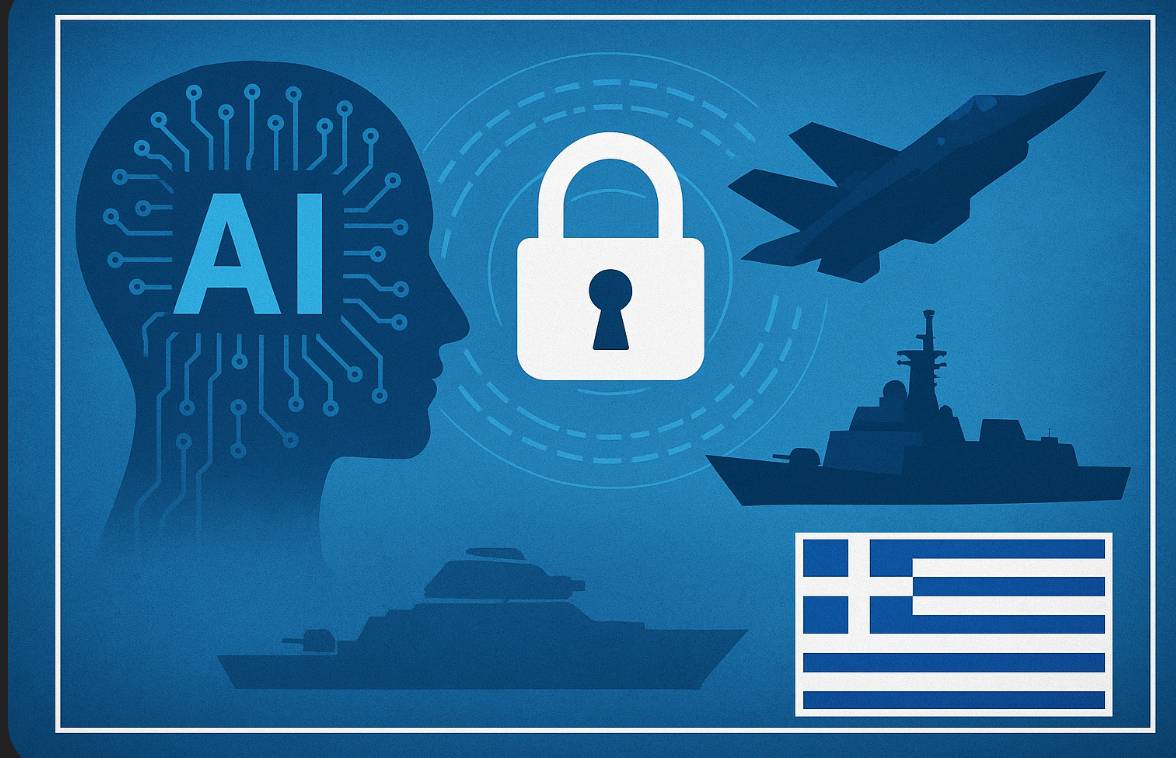
Artificial Intelligence and Cybersecurity in Greece's Military Strategy: New Dimensions of War and Deterrence in the Eastern Mediterranean.
By Mr. Alex Saltout, Member of ELISME.
The rapid advancement of Artificial Intelligence (AI) and cybersecurity has brought about a fundamental change in the way states plan and implement military tactics. These developments are not limited to a technological level, but directly affect the strategic balance of power in the Eastern Mediterranean and in particular in the Greek-Turkish context of confrontation. For Greece, the integration of AI and shielding against cyber threats are not a luxury, but a strategic imperative for ensuring national sovereignty and deterrence.
AI's Entry into the Battlefield
AI has already transformed the way military data is collected, analyzed, and utilized. Machine learning algorithms are used to detect threats more quickly, analyze satellite imagery, and predict enemy movements. In the Eastern Mediterranean, where the operational landscape is characterized by intense naval mobility, the use of AI allows for the immediate analysis of data from sensors and UAVs, ensuring network-centric superiority (European Defence Agency, 2024).
Turkey is already using AI elements in its Bayraktar-type UAVs, enabling autonomous flight, targeting and real-time analysis (Kibaroglu, 2023). Similarly, Greece is attempting to incorporate autonomous navigation and target recognition technologies into its “Archytas” program, while considering the creation of a national AI center for military applications (Kathimerini, 2024). As noted in Beyond War & Stars , “AI is not a tool; it is the battlefield of the future itself” (p. 157).
AI and Military Tactics in Greece
The use of AI in the Greek Armed Forces can upgrade critical tactical aspects:
- Instead-drone businesses: AI can detect suspicious UAVs in seconds, distinguishing them from civilian drones.
- Network-centric businesses: through smart interconnection of all means (from frigates to sensors in Evros).
- Digital war simulation: combat scenarios based on real-time data, aiming at proactive deterrence.
According to Beyond War & Stars , “whoever has the fastest algorithm has the first step in the field” (p. 183).
The Invisible Front of Cybersecurity
Cybersecurity is now the foundation of every military operation. From attacks on air defense systems to interference in telecommunications networks, the threats are multiple and often undetectable. Greece has already suffered cyberattacks on critical infrastructure (ENISA, 2023), which highlights the need for a multi-layered cyber defense doctrine.
The creation of the National Cyber Security Center and participation in the European Cyber Rapid Response Team are important steps, but the challenge remains to integrate AI into these systems. As Beyond War & Stars points out : “cyberwar will not be judged on repelling, but on predicting the next strike” (p. 202).
The Hybrid Dimension of AI and Cyberwarfare
The new type of warfare is not linear. AI and cyberattacks are part of a hybrid doctrine that combines military power with information warfare, psychological operations, and social media manipulation. Turkey has repeatedly demonstrated its ability to use disinformation and cyber influence tools in conjunction with a military presence (Hoffman, 2009).
Greece, to respond to this challenge, must develop national AI platforms that combine big data analysis with proactive cyber defense models.
Collaborations and Technological Autonomy
Cooperation with the US, Israel and the EU provides Greece with access to advanced AI and cybersecurity technologies. However, total dependence carries risks. As Beyond War & Stars states , “technological independence is the ultimate weapon of deterrence; without it, no alliance is enough” (p. 219).
The challenge for Greece is to balance international cooperation and the development of national know-how. The "Archytas" program is a first step, but the creation of a Greek defense AI is the strategic goal of the next decade.
Conclusions
Artificial Intelligence and cybersecurity are not just new tools; they are the very nature of warfare in the 21st century. For Greece, investing in these fields is tantamount to investing in national survival. The combination of AI, UAVs, and cyber defense can transform the country from a defensive player to a powerful deterrent in the Eastern Mediterranean.
As Beyond War & Stars states , “tomorrow’s war will be invisible, instantaneous, and unpredictable; and it will be won by the one who predicted the algorithm before it was written” (p. 231).
Bibliography
- ENISA (2023). Annual Threat Landscape Report. European Union Agency for Cybersecurity.
- European Defense Agency (2024). AI in Defence: Strategic Perspectives.
- Hoffman, F. (2009). “Hybrid Warfare and Challenges.” Joint Forces Quarterly, Issue 52.
- Kibaroglu, M. (2023). “Turkey's Military AI Strategy.” Middle East Institute.
- Ministry of National Defense (2024). Annual Report on National Defense.
- Kathimerini (2024). “The creation of a National AI Center for Defense.”
- Beyond War & Stars: The Future of Weapons, Space, and Humanity (2024).