

Why Greek shipping is in the EU's sights
Why Greek shipping is in the EU's sights

A special team of the European Commission is expected to arrive in Athens soon to monitor compliance with sanctions against Russia and to seek ways to cooperate with the Greek authorities for their better implementation. Although the team has already visited several EU member states, Greece is considered a special case, because its institutional weaknesses in prosecuting money laundering rings are well known (e.g. it is the only country that did not receive compensation from HSBC Geneva and the involved offshore companies, even in the easy case of the Lagarde list).
Furthermore, at present, the – until now legal – process of transporting Russian oil by Greek shipping companies to third countries outside the West is being over-exploited, while there is also an increase in transactions with countries that have not adopted the sanctions, such as Serbia and Turkey. The members of the Commission team will meet with officials from the Ministries of Foreign Affairs and Finance, the Bank of Greece, the Anti-Money Laundering Authority and other bodies.
The “inspection” by the special team coincides – coincidentally or not – with the consultations between the European Union, the US and the G-7 on the faithful implementation of sanctions and, above all, “the neutralization of those who facilitate the circumvention of sanctions” . In this context, emphasis is placed on three chapters of the case:
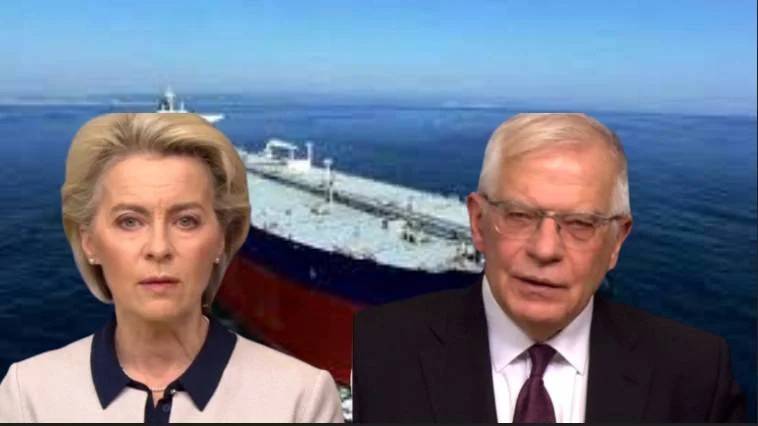
Firstly, the Commission, through the imminent adoption of the 11th sanctions package, is now determined not only to restrict the general activity of – Greek and other – shipping companies transporting Russian oil, but also to prevent suspicious ships from approaching European ports. In order to appease the reactions, the Commission gives the – cynical as well as ironic – answer that, with the new provisions, the Greek authorities will have a smaller workload, as suspicious ships will avoid approaching the country’s ports.
However, this is a false argument, since the same ships will cross national territorial waters, so the Greek authorities, in any case, have the responsibility of control and prosecution. Also, although there is no jurisdiction beyond six nautical miles, in practice the Greek authorities will still have – informally – the responsibility or even interest in monitoring shipping in the Aegean and critical areas of the Southeastern Mediterranean. The Commission’s decisions will cause friction between shipping companies and the government that will emerge after the June 25 elections, while the effects on the national economy should not be ignored.
Focused on the US and EU
Secondly, at the instigation of Washington, the Commission proposes the management of the “immobilized” (and not “frozen”) funds of the Central Bank of the Russian Federation, aiming to strengthen the economy and reconstruct Ukraine. In addition to the political and diplomatic aspects of the proposal (resurgence of tension between the Kremlin and the EU), the important legal issue arises of how it is possible to manage funds of a third state that are temporarily “immobilized” and not seized. If they had been frozen or seized, the older models of measures (against Iran, Iraq, Serbia, Venezuela, etc.) would simply be copied.
Third, Brussels and Washington are focusing on the implementation of the 9th sanctions package (of December 16, 2022) on dual-use goods. Among other things, it has been observed that devices containing a specific type of “microchip” are being transported – also via Greece – to the outskirts of Belgrade and Istanbul. The “microchips” are then removed to be used in Russian weapons systems, the production of which had slowed down in recent months due to the sanctions. It is also noted that, after the elections, the issue of new shipments of defense equipment from Greece to Ukraine will be examined.